Reading Between the Reads: Why the Utility's Billing Calendar Seldom Matches Your Usage Calendar
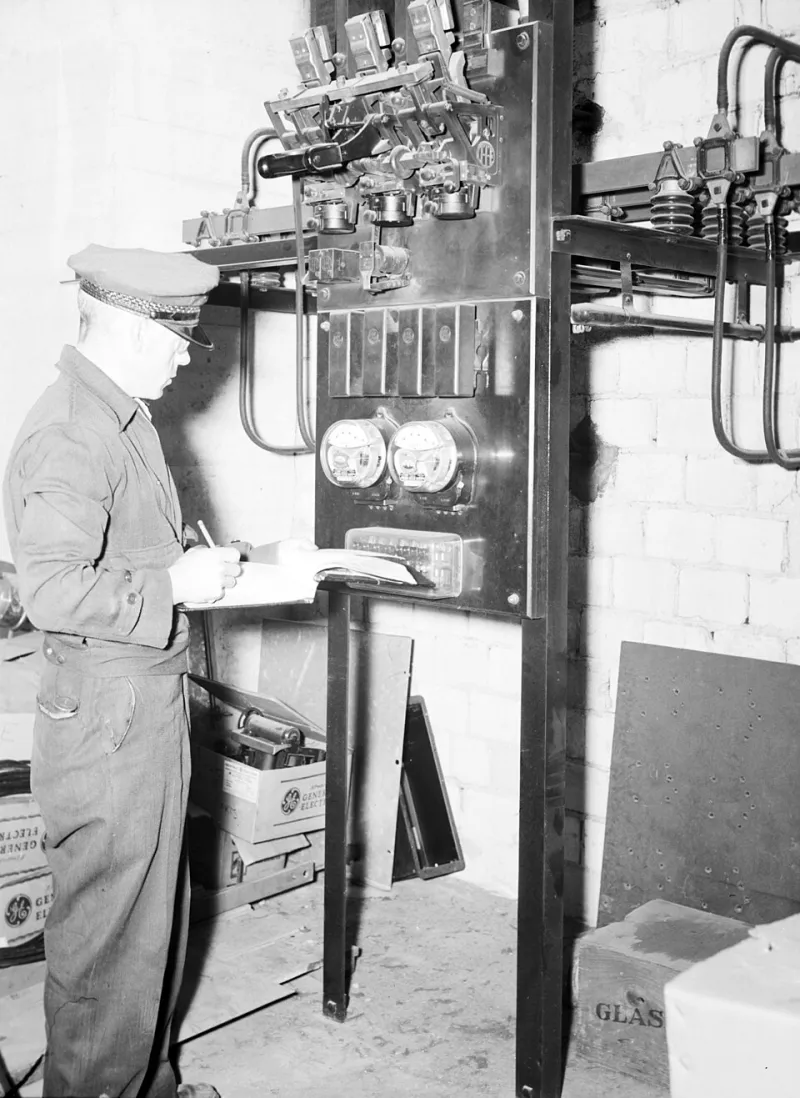
Photo: Seattle Municipal Archives from Seattle, WA, CC BY 2.0, via Wikimedia Commons
Most households treat the electric bill as a receipt: a document that arrives after the fact and describes what already happened. In practice, it is closer to a forecast with a correction attached. For a meaningful share of American accounts, the figure printed on the statement does not rest on a measurement taken that month. It rests on a projection derived from past behavior, and the settlement of that projection can arrive months later, frequently in the season when consumption is least forgiving.
The Mechanics of an Estimated Read
A regulated utility reads meters on fixed route schedules, grouping accounts into cycles so field crews can move through a territory in an orderly sequence. When a read cannot be obtained, the billing system substitutes a calculated number. The obstacles are mundane and recurring: a locked gate, a meter inside a fenced enclosure, a dog in the yard, a vacant property, a flooded access road, or a staffing shortfall on the route itself.
The estimate is not a wild guess. It is a modeled projection, typically built from the same customer's usage in the corresponding period a year earlier, sometimes adjusted for weather norms and recent consumption trends. Directionally, these models are usually sound. What they are not is a measurement. The variance between projection and actual use does not vanish when the statement is issued; it accumulates in a deferred balance that is settled whenever a genuine read is finally captured.
Two Calendars, One Statement
Every account is governed by at least two timelines that rarely align. The first is the consumption calendar, which reflects weather, occupancy, appliance replacement, a new electric vehicle in the garage, or a work-from-home schedule that shifted in the last year. The second is the billing calendar, which reflects route logistics, the number of business days in the cycle, holiday schedules, and how many prior estimates have stacked up.
A statement is therefore a snapshot of one timeline rendered in the units of the other. When the two drift apart by a modest amount, the bill looks stable. When they drift apart by several months, the reconciliation can be large enough to read as an error even when the arithmetic is correct.
Smart Meters Did Not Retire the Estimate
Advanced metering infrastructure has reduced the frequency of estimated bills in many service territories, and where deployment is complete, interval data generally supports accurate monthly billing without a field visit. The transition, however, has not been uniform. Meter replacements occur in waves, communications networks fail in specific geographies, and some properties retain older equipment for reasons ranging from access to ownership disputes in multi-tenant buildings.
There is a second wrinkle. A utility that can read a meter remotely still has to convert interval data into a bill through its own systems, and a data gap in a communications blackout can produce the same estimated entry a locked gate once did. The mechanism changed; the possibility did not.
The Seasonal Multiplier
Estimates are least dangerous when consumption is flat. They become consequential when usage is steeply seasonal. A projection built on last January's consumption, applied to a January in which a household added a heat pump or a second electric vehicle, understates use. A projection built on last July, applied to a July in which a household was away for three weeks, overstates it.
The asymmetry matters because it interacts with rate design. In jurisdictions with seasonal rate tiers or time-of-use periods, the reconciliation does not merely move kilowatt-hours between months; it can move them between price bands. A summer estimate that understates usage pushes consumption into a later period where the marginal price may be higher, and the true-up then reflects both the volume correction and the price differential.
Reading a True-Up Statement
Reconciliation statements vary by utility, but most disclose three things: the period during which estimates were applied, the difference between estimated and actual consumption, and the resulting adjustment to the current balance. A customer auditing one should look first at the number of consecutive estimated reads. A single estimate is routine. Four or five in sequence usually indicates an access problem that will not resolve on its own.
Second, compare the estimated figures against the same months of the prior year and against the customer's own records, if interval data is available through the utility portal. Third, check whether the adjustment was spread across future bills or applied in a single statement; many commissions permit installment treatment on request, which is materially easier on household cash flow than a lump-sum correction.
Challenging an Estimate That Looks Wrong
Disputes are more effective when framed as a data question rather than a billing complaint. The productive request is for the read history: the dates on which actual reads were obtained, the dates on which estimates were substituted, and the basis used for each projection. Utilities are generally obligated to provide this on request, and in several states the information is now available directly through the account portal.
If access was the underlying cause, resolving it is often as simple as arranging a new meter location or providing a key. If the estimate was generated from an incorrect historical baseline, correcting the baseline is the remedy. Escalation to a state public utility commission is available when a utility cannot substantiate the projection, but it is a slower path and generally reserved for unresolved disputes.
A Bill Built on Two Calendars
Estimated billing is not a defect in the system so much as a concession to physical reality: meters must be visited, routes must be scheduled, and not every visit succeeds. The practical lesson for consumers is that a bill is a claim about a period, not a verdict on a month. The lesson for the industry is that the timing mismatch between consumption and settlement is where the sharpest customer dissatisfaction originates, and it is cheapest to address through transparency about read dates than through explanations issued after the shock has already landed.